
Finding the Mermaid
on stuff: keeping it, losing it

The prompt was to write about the texture of something in the room. It was the first morning of an eight-week workshop, a Zoom gathering of writers in the U.S. and Canada, all of us nudging a project forward in community. My project: this Substack. My texture: the softness underfoot of the Persian rug on my bedroom floor.
The rug came from my husband Chris’s parents’ house, shipped to us along with a set of bedroom furniture after his father died in 2012. It was delicious to write about its light autumnal colors, how it kept the floors from squeaking when sneaking to the bathroom at night, the feel of wool under my toes in the morning.
Twenty-four hours later I was in Big Sandy Creek, a community in the far northwest of Travis County that experienced heavy flooding over the July 4th weekend. At least 10 people had died and houses were destroyed, but help was slow in arriving. I’d seen a news article saying they needed volunteers to clean up flood damage in the area. I had an unscheduled day, so I headed out, 20 minutes past the farthest northwest I ever go in Austin. I joined a cluster of volunteers, all of us in our gloves and long pants. We sorted through piles of brush, downed trees, and stuff. So much stuff.
The day before I had written, “The thing about a home is that everything in it came from somewhere—the store, Craigslist, a gift, or like this rug and bedroom furniture, someone else’s house.” Now I was helping sort the everything of other peoples’ homes—the space heater, the throw rugs, the bedframe, all of it mud-encrusted and smashed up and tangled into awkward heaps.
**
The rug I wrote about is something I can imagine I’ll feel under my feet for the rest of my life. Why wouldn’t I? Rugs have a way of sticking around.
In my living room is another carpet, this one bought with an ex-boyfriend in Turkey 30 years ago. We were in the town of Göreme, and among the hundreds if not thousands of kilims we had looked at, this one stood out for its bright, geometric pattern. We bought it, and folded it into the smallest package we could, and my boyfriend wedged it into his backpack and carried it the rest of the trip. Back home in Cincinnati, we spread it on the sloping floors of the old Victorian where we had a carved-out apartment, and when we split a year or two later, we considered fighting over the rug, but didn’t. It’s been with me ever since.
“Ever since” is what I expect of the carpet in the bedroom. Like the bedroom furniture, purchased by Chris’s newlywed parents in 1953, a young couple just starting their lives together. More than 70 years later, I am married to the third of their four children, we live clear across the country from that first Bronx apartment, and the dresser holds my t-shirts and leggings, the side table my stacks of books. Certain things last, I can believe, sitting in my comfortable and intact bedroom.
But do they? The recent floods in Central Texas and dozens of disasters, manmade and natural, that just keep coming--the fires, hurricanes, tornadoes, invasions—show us that our homes aren’t permanent, as much as we imagine they are. And our things, the ones that we think are central to what we make of a space, can sweep right down a river and out of our lives.
**
I went back to Big Sandy Creek for another shift. This time I was sent with a crew to clean up the woods behind someone’s home, a scrubby area above the creek bed where things that had been washed downstream were carried up and deposited in the brush. Branches hung precipitously from trees. As we worked our way in and out of the woods, we started three piles closer to the road– one for logs and brush, one for scrap metal, and one for trash. The trash, pretty much every bit of it, was the stuff of someone’s home. Crushed mugs, so many pieces of glass, a golf ball, a patio umbrella, its red like a flag in the tangle of Central Texas woods. A child’s dump truck, a computer keyboard.
And then the rugs. Rugs, released from the floor, become something else altogether. They wrap around things, tear to pieces, unravel themselves to link up the rest. I stood for a while in the woods in front of pile of stuff and grabbed the edge of a rag rug, its bulk wedged beneath a pile of brush. I pulled and tugged and tried to shimmy it, until I finally I realized I couldn’t move it on my own. I left it for someone stronger.
When our work was done, we stood in the shade and sipped water flavored with salty packets of electrolytes. Soon the chainsaw crew would arrive, and later the trucks to haul away what we’d recovered from the woods. Our progress that day was important and insufficient. The needs were far larger than any of us could address.
**
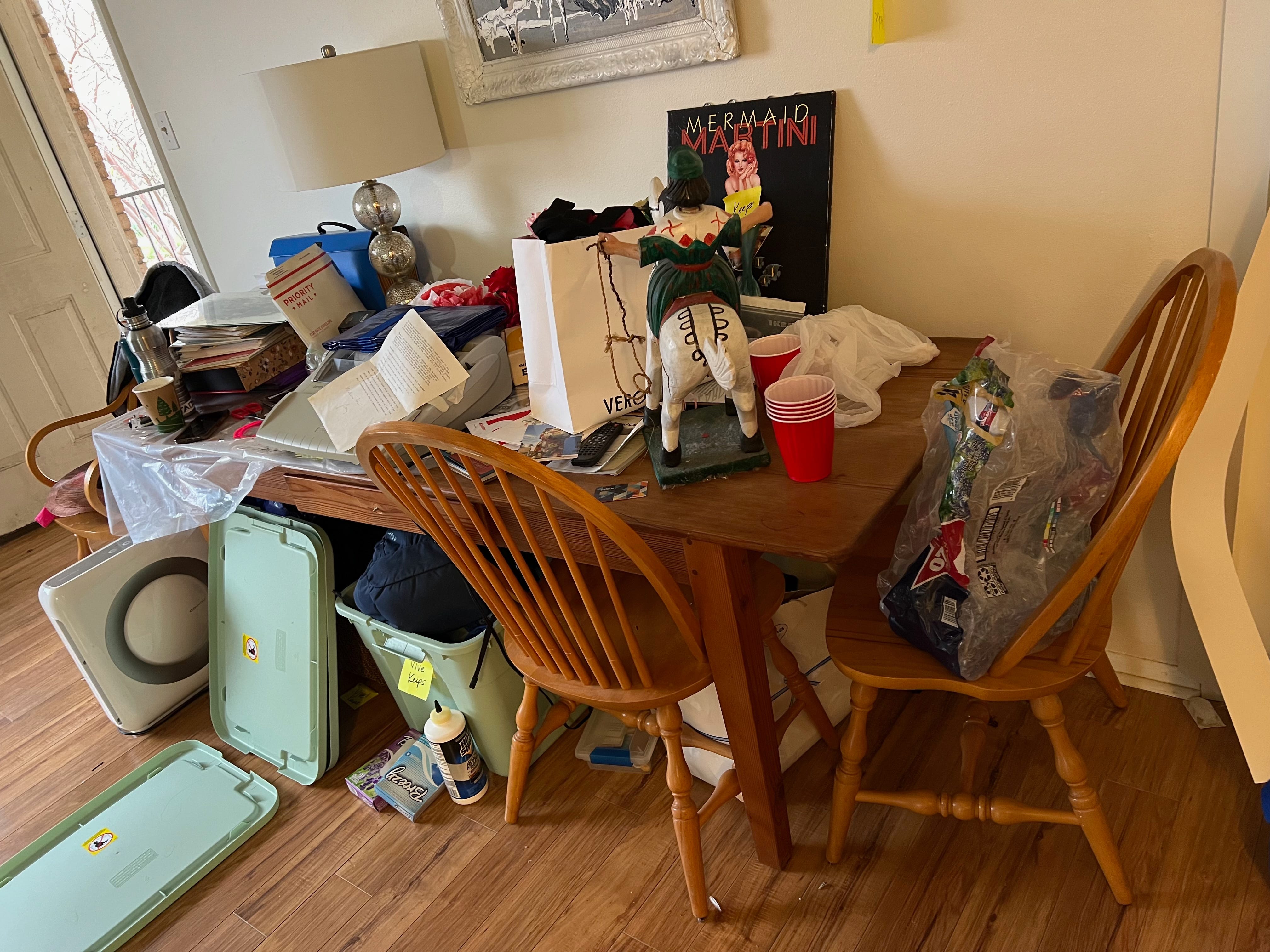
When she died, my mother had three apartments – two small side-by-side condos in Florida and a one-bedroom rental in Austin. She had filled each of those apartments to their proverbial rafters, unapologetically accumulating both what you’d expect—clothing and art supplies—and what you’d never think—seven back scratchers, half-finished containers of protein powder, tea sets, and pasta bowls with cartoonish figures of waiters painted inside. The apartments had to be cleaned out quickly, so this winter—with the help of friends, family, and professionals—I sorted through more stuff than I could have imagined, more stuff than I could possibly make sense of.
Many of us have been through this, combing through the layers of someone’s life, the hobbies and style choices and mini-obsessions, the papers they held onto, the books with little notes popping from the top, the yellowing photos sliding out of photo albums. My mother loved linen clothing, anything on sale at Anthropologie, paintings—her own, her friends’, the ones on auction at the local Goodwill—and mermaids.
Her bathrooms in Austin and Florida were filled with mermaids – pithy plaques announcing, In a world where you can be anything, be a mermaid and her own canvases of stylized mermaids donning shell bikinis. Mermaid towels. Mermaids fashioned of metal and dangling from the towel bars. To each doctor we saw during her illness, she announced, “I am a mermaid,” explaining the time she spent in the pool and her certifications in aquatic exercise. Her homes suggested the same.
The work of the winter was in clearing and also in trying to understand that things that I cleared were not my mother, in the end. They were stuff. Except some of that stuff had meaning. I took home more than I had room for, much of it now sitting in plastic bins in my closets.
**
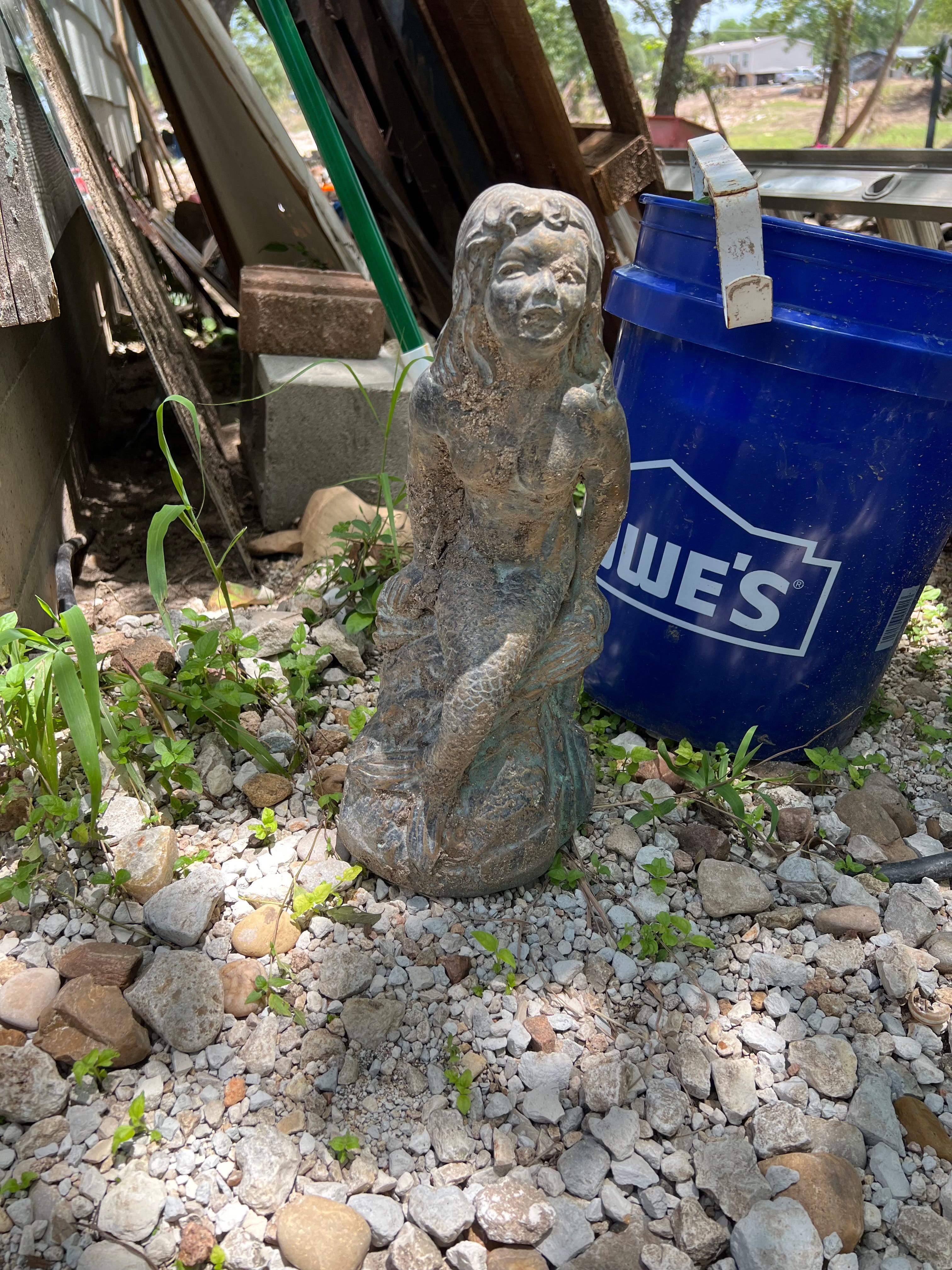
On my first visit to Big Sandy Creek, our crew cleared brush near the washed-out bridge, then moved further up the riverbank, working through piles. We were a flurry of activity, strangers in our sunhats filling the wheelbarrows and then rolling them up to the street. We pulled out a grocery cart, the hand-painted side of a shed. And then under some brush I found a mermaid, a concrete garden mermaid lying on her back and staring at the sky. All around us were things smashed into bits, but the mermaid was whole.
Since my mother died, I’ve felt her most acutely when I see a mermaid. And they have popped up all over – sitting on the counters of restaurant bathrooms, dangling from keychains, staring at me from murals on city walls. Mermaids everywhere, even here on a dusty riverbank in Central Texas.
I stared at the mermaid, then reached down to stand her upright on the ground. “I found a mermaid,” I told the woman who was sorting with me. She walked over to look at it.
“Maybe it belongs to their house,” she said, pointing at the half-standing home below which we were working. “The homeowners might want that.” So I lifted the mermaid in my two hands and carried her up the riverbank to the foundation of the house, where ladders and buckets and random items were accumulating. I nestled her safely behind a ladder.
On the way back to the pile, I passed a woman I knew had lived in the house. She wore a wide-brimmed hat over her buzzed hair. Tattoos of feathers wrapped her forearm.
“I found a mermaid,” I said.
“You found a mermaid,” she repeated. Then she stopped short.
“A mermaid statue?” she asked, “You found the mermaid statue?” Her eyes filled as I nodded my head.
“That was my grandmother’s. My mom will be so happy.”
Her face had changed, and she was crying in earnest now. We looked at each other, a moment of connection, strangers on the side of a riverbank. And so I said it: “I’m so glad I found it. I lost my mother this year, and she loved mermaids, so I always think of her when I see one.” Something passed between us, some understanding of loss and small miracles.
“May I hug you?” she asked.
We embraced, there on the land where she had made a life and seen a life washed away. Then I watched as she hurried up the hill to the house, scooped up the mermaid, and carried her across the yard to her mother. Her mother’s hands flew to her chest when she saw her, then she reached out to stroke the mermaid’s head like it was a puppy to be soothed.
One thing wasn’t lost. One thing came back to her.
**
I’ve been trying to write about place and change, and thus far the change I’ve experienced has been disorienting but not fatal. Eleven houses on a street becoming 23. The closure of Drive-Thru Postal. The upcoming tearing down and building up of the interstate. The demolition sign on the corner. But there are larger changes that take away everything.
Our question has not been, What do we do now that everything is gone? It has been, Do we stay when everything has changed? It’s been the mythical ship of Theseus, asking if a place is still itself after all its parts have been replaced.
I’ve come to believe that what I’ve witnessed in Austin over the past decade or two has been a kind of collective grief. There was a place that so many of us knew as home, and it’s not the place that it used to be or the place we chose when we were choosing. We grieve the loss of what we’ve known, of what we have loved. We grieve wishing for something—or someone—that’s not coming back.
That grief can be clarifying. A host of friends have decamped for new places, built their lives elsewhere. Others have surrendered to the transformation. In a changing city, a changing climate, a changing country, we keep being reminded that everything is tender, everything is tenuous. What we thought we could count on may not be what we can count on, whether that’s the four walls that surround us or the way my feet reach for the rug when I get out of bed.
Theseus indeed! Another lovely essay, Vive, and you know I so relate about the stuff, the stuff, the winnowing, the loss, the grief.
Vivé, I'm so glad our mutual Taos friend forwarded this to me. You write beautifully, and this subject resonates deeply for me. Perhaps you're familiar with The Minimalists; their film Minimalism [ https://www.youtube.com/watch?v=J8DGjUv-Vjc ] and book "Love People, Use Things" [ https://celadonbooks.com/book/love-people-use-things/ ] were game changers for me in how I view and deal with "stuff."
I'm also happy to find you here on Substack, for I'm been thinking about joining this community. Thank you for being an inspiration. ✨✌️